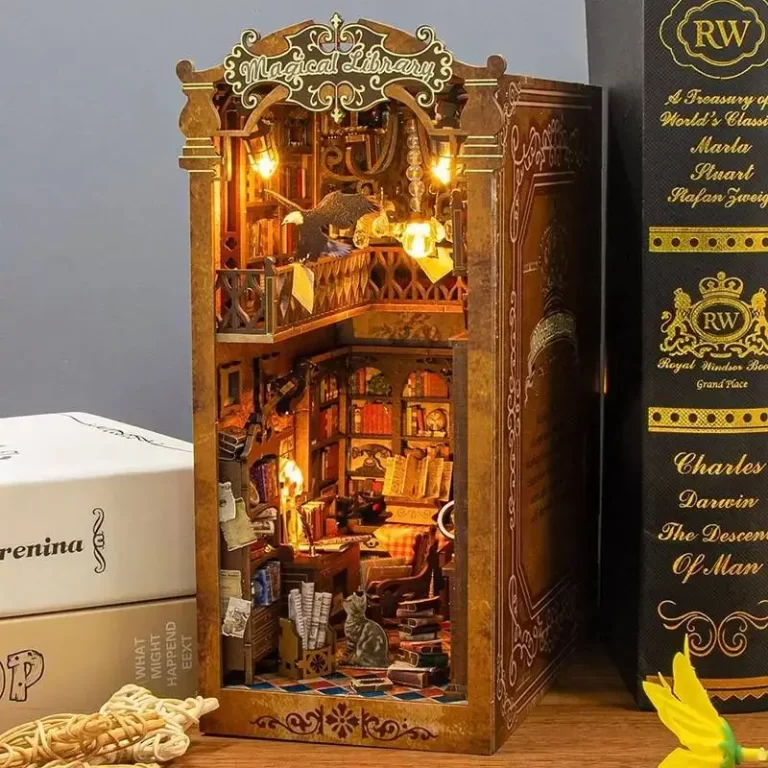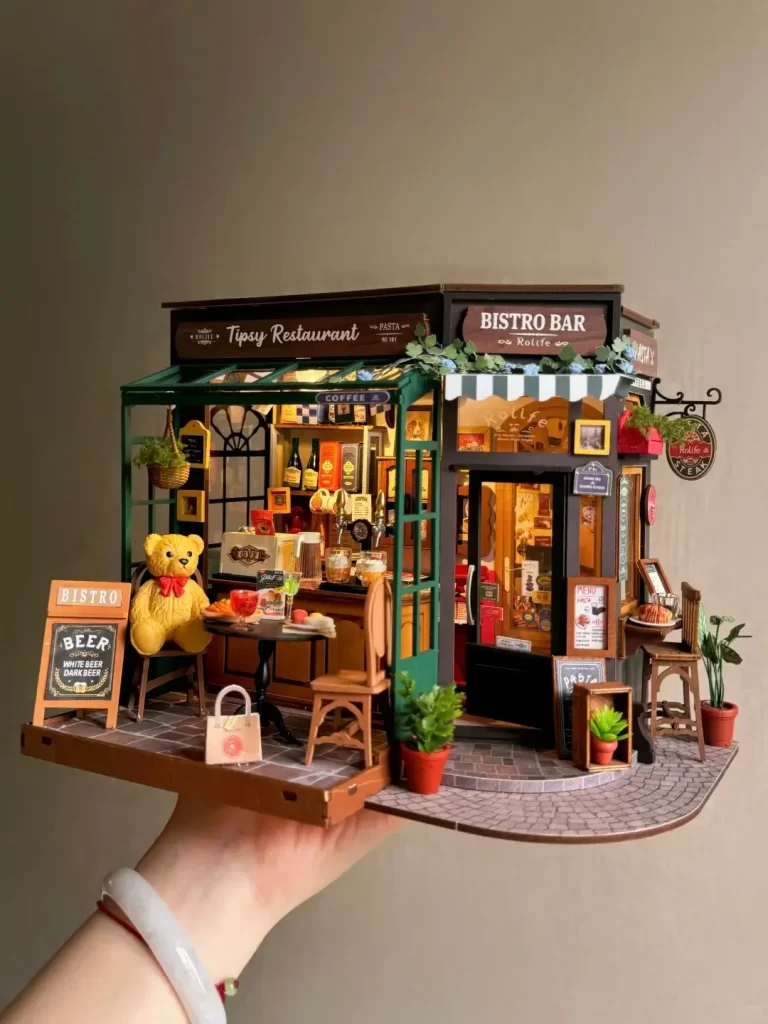
Wholesale 3D wooden puzzles combine hands-on assembly, model building, decorative design and, in some products, working mechanical or musical functions.
Unlike a flat jigsaw puzzle, a 3D wooden puzzle is assembled from precision-cut wooden sheets into a freestanding object. The finished model may become a vehicle, musical instrument, Ferris wheel, carousel, gramophone, building, animal, cultural landmark or mechanical display piece.
This combination gives retailers several ways to position the category. A simple model can serve as an entry-level craft kit, while a detailed mechanical music box can be presented as a premium hobby product, collectible model or creative gift.
However, buyers should not judge a product only by its finished photograph. Material stability, cutting accuracy, slot fit, gear alignment, mechanical performance, instruction quality, component completeness and packaging protection all affect the final customer experience.
This guide explains what retailers, importers and private-label brands should check before ordering wholesale 3D wooden puzzles or developing a customized wooden model range.
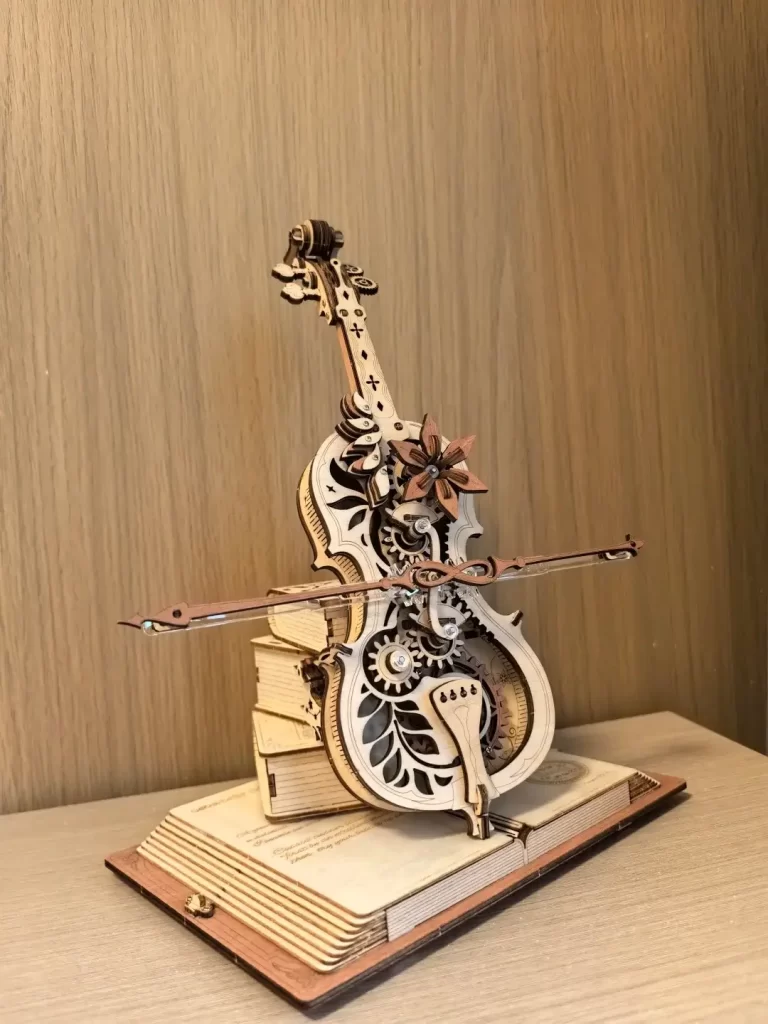
Table of Contents
What Is a 3D Wooden Puzzle?
A 3D wooden puzzle is a self-assembly model made primarily from pre-cut wooden parts.
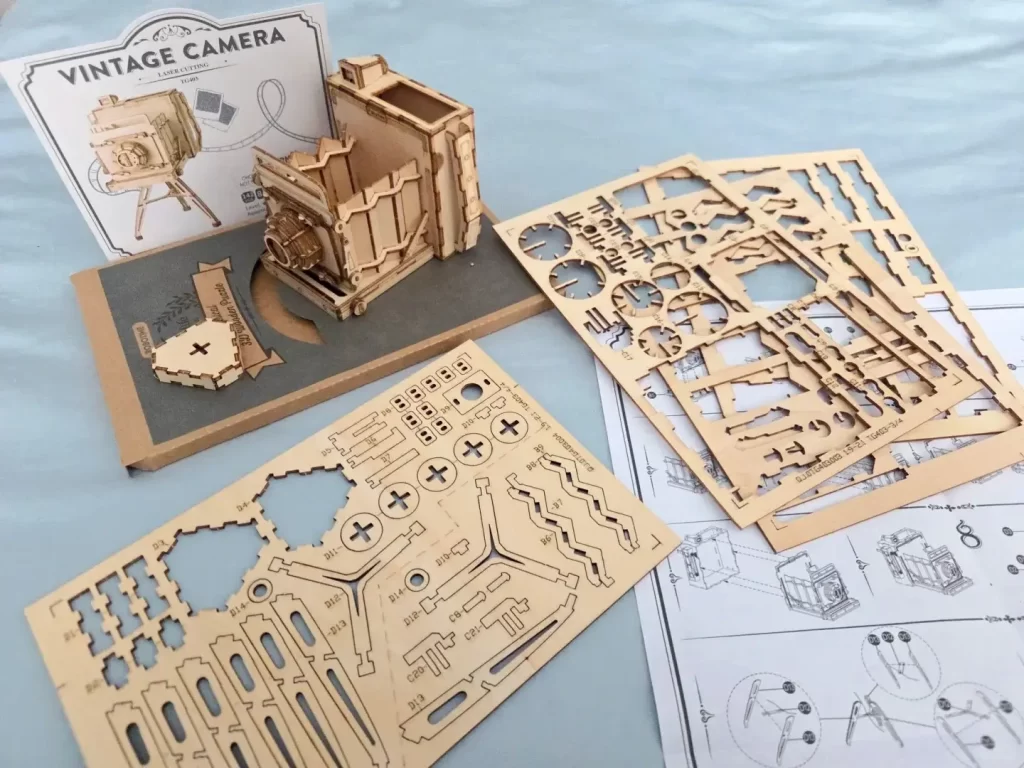
The components are usually supplied in flat sheets. Users remove the numbered pieces and connect them according to an illustrated instruction manual.
Depending on the design, assembly may involve:
- Press-fit tabs and slots
- Gears and axles
- Rotating components
- Rubber bands or springs
- Mechanical music movements
- Hand-crank mechanisms
- Electric motors
- LED lights
- Plastic or metal accessories
- Decorative printing or engraving
The finished product is both the result of the puzzle and a display model.
This category may also be described as:
- 3D wooden puzzle kits
- Wooden mechanical model kits
- DIY wooden model kits
- Wooden construction kits
- Laser-cut wooden models
- Wooden music box kits
- Mechanical wooden puzzles
Using several natural terms in product descriptions can help international buyers understand the product, but the main category name should remain consistent across the website.
How Are 3D Wooden Puzzles Different from Jigsaw Puzzles?
A traditional jigsaw puzzle creates a flat image. The customer connects individual pieces on a table until the picture is complete.
A 3D wooden puzzle creates a freestanding structure. The pieces form walls, frames, gears, wheels, instruments or other three-dimensional components.
The two categories therefore require different quality checks.
For a cardboard jigsaw puzzle, buyers mainly evaluate printing, board quality, die cutting and piece fit.
For a 3D wooden model, buyers must also evaluate:
- Structural alignment
- Slot dimensions
- Axle position
- Gear engagement
- Mechanical resistance
- Moving components
- Finished stability
- Assembly sequence
- Instruction accuracy
Flat wooden picture puzzles should normally remain in the Jigsaw Puzzles category. Freestanding wooden models belong in 3D Wooden Puzzles.
Main Types of 3D Wooden Puzzles
A balanced wholesale collection can contain several product types rather than relying on one theme.
Decorative Wooden Models
Decorative models focus mainly on appearance and assembly.
Examples may include:
- Buildings
- Cultural landmarks
- Animals
- Dinosaurs
- Plants
- Fantasy scenes
- Seasonal decorations
- Musical instruments
These models can work well for gift shops, museum stores, cultural retailers and entry-level hobby ranges.
Mechanical Wooden Models
Mechanical products include visible moving structures such as:
- Gears
- Wheels
- Cranks
- Linkages
- Rotating platforms
- Opening compartments
- Steering or transmission structures
The customer can observe how the parts interact after assembly.
These models are particularly suitable for hobby stores, educational retailers and customers who enjoy engineering-style projects.
Wooden Music Box Kits
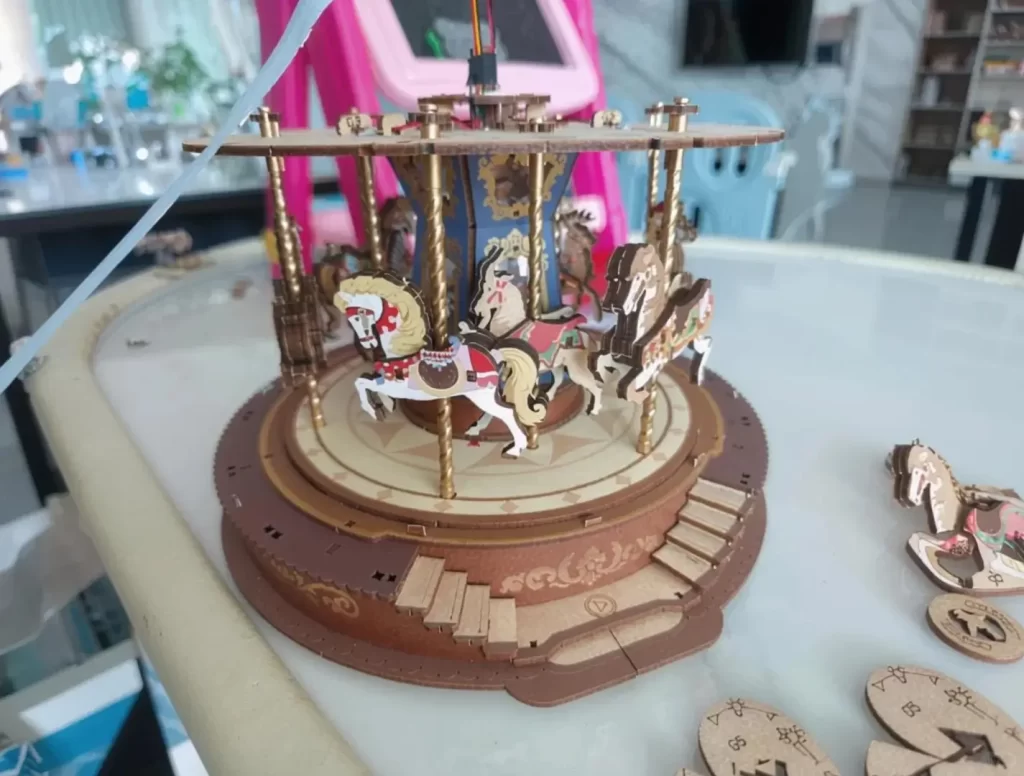
Music box kits combine model assembly with a mechanical or electric music movement.
Available operating formats may include:
- Wind-up movements
- Hand-crank movements
- Electric movements
- Rotating platforms
- Moving decorative parts
- Combined music and lighting effects
Popular themes include carousels, Ferris wheels, gramophones, musical instruments, theaters, city scenes and seasonal designs.
Vehicle Models
Vehicle models can include:
- Vintage cars
- Sports cars
- Racing cars
- Off-road vehicles
- Trucks
- Construction vehicles
- Motorcycles
- Trains
- Electric vehicles
Some are primarily decorative, while others include moving wheels, steering systems, motors or mechanical transmission structures.
Compact and Mini Models
Compact kits use smaller finished dimensions and retail packaging.
They can be suitable for:
- Entry-level products
- Souvenir stores
- Small gifts
- Counter displays
- Promotional projects
- Lower-volume parcel shipping
A small model is not automatically easy. Tiny components may require more careful handling than larger pieces.
Cultural and Souvenir Models
Buildings, landscapes, city symbols and regional cultural elements can be developed into wooden models or music boxes.
These products are suitable for:
- Museum shops
- Tourist attractions
- Cultural institutions
- Destination gift stores
- Promotional projects
- Local private-label collections
Artwork and design rights should be confirmed before production.
1. Define the Intended Customer and Difficulty Level
Before selecting a model, buyers should identify who will assemble it.
Important factors include:
- Customer age
- Previous model-building experience
- Expected assembly time
- Number of components
- Size of the smallest pieces
- Mechanical complexity
- Required tools
- Retail price level
- Gift or hobby positioning
A low part count does not always mean an easy project. A compact music movement with small gears may require more precision than a larger decorative model.
Difficulty should be evaluated by assembling a complete sample.
A practical range may include:
- Entry-level decorative models
- Intermediate music boxes and vehicles
- Advanced mechanical models
- Premium interactive or motorized products
Retailers should avoid using “easy,” “beginner” or “advanced” only according to the supplier’s description. The classification should reflect the actual assembly experience.
2. Confirm the Main Material and Board Specification
Most 3D wooden puzzles use thin plywood, engineered wood or another laser-cut wooden board.
The material should be evaluated for:
- Flatness
- Thickness consistency
- Strength
- Flexibility
- Surface smoothness
- Resistance to splitting
- Moisture stability
- Cutting performance
- Printing performance
- Odor
A sheet that is too soft may bend during assembly. A board that is too brittle may break around narrow tabs or gear teeth.
The required material depends on the model.
A decorative panel may prioritize appearance, while a gear, axle support or structural frame requires better dimensional stability.
For customized orders, the approved specification should record:
- Board type
- Board thickness
- Surface treatment
- Color
- Printing or engraving method
- Applicable material reports
The production material should match the approved sample.
3. Inspect Board Flatness Before Assembly
Warped wooden sheets can create problems even when the cutting pattern is correct.
Possible effects include:
- Misaligned walls
- Gears that do not engage
- Frames that lean
- Wheels that touch the body
- Rotating platforms that become unstable
- Poor-looking gaps between layers
Sample sheets should be checked on a flat surface before the pieces are removed.
Packaging should also keep the sheets flat during storage and transportation.
Long or narrow boards may require additional support inside the retail box.
4. Check Laser-Cutting Accuracy and Edge Quality
Accurate laser cutting is central to the assembly experience.
Buyers should inspect:
- Cut completeness
- Tab dimensions
- Slot dimensions
- Gear teeth
- Axle holes
- Narrow decorative parts
- Curved components
- Edge consistency
- Dark burn marks
- Splinters
- Residual attachment points
The pieces should be easy to remove without tearing the surface.
A small amount of sanding may be normal for certain wooden model kits, but customers should not need to reshape major components or enlarge multiple slots manually.
Selected production configurations can control cutting and board variation to approximately 0.2 mm. The appropriate tolerance should still be confirmed for the actual structure and material.
Mechanical models usually require tighter and more consistent fitting than simple decorative models.
5. Test Tabs, Slots and Structural Fit
Press-fit connections should be secure without requiring excessive force.
If the fit is too loose:
- The model may become unstable
- Walls may move
- Gears may lose alignment
- Decorative parts may fall out
If the fit is too tight:
- Tabs may break
- Board layers may separate
- Customers may need to sand every connection
- Assembly becomes frustrating
During sample assembly, record every connection that requires unusual force, repeated sanding or glue.
The completed model should be checked for:
- Stability
- Squareness
- Symmetry
- Level surfaces
- Straight side panels
- Correct positioning of moving parts
A flat sheet inspection cannot replace complete sample assembly.
6. Evaluate Gears, Axles and Moving Mechanisms
A mechanical model must do more than look correct.
Moving mechanisms should be tested repeatedly after assembly.
Check:
- Gear alignment
- Gear-tooth engagement
- Axle position
- Rotational resistance
- Wheel movement
- Crank operation
- Linkage movement
- Contact between moving and fixed parts
- Noise
- Wear after repeated use
A mechanism that works only once during the sample demonstration may not be reliable enough for retail production.
The instructions should clearly show:
- Which parts must remain movable
- Where wax or lubrication is required
- Which direction gears should face
- How tightly axles should be installed
- How to correct excessive friction
For motorized models, the mechanical system should also be tested under continuous operation.
7. Confirm the Music Movement and Operating Version
Music box products may use different operating systems.
For example, the same model concept may be available as:
- Electric version
- Wind-up version
- Hand-crank version
These should be treated as separate specifications.
Buyers should confirm:
- Movement type
- Music selection
- Operating method
- Rotation function
- Music duration
- Mechanical connection
- Motor or battery requirement
- Volume consistency
- Replacement availability
- Packaging protection
Music movements and small mechanical components should be protected from pressure and impact inside the box.
If the model includes both music and movement, the sample should be tested after full assembly to ensure that the transmission works correctly.
8. Check Electric Components and Battery Requirements
Some 3D wooden puzzles include:
- Motors
- Battery boxes
- Switches
- Wires
- LED lights
- USB power components
Before bulk ordering, confirm:
- Voltage and power method
- Battery type
- Whether batteries are included
- Switch location
- Wire length
- Connector type
- Motor performance
- Lighting position
- Accessibility after assembly
- Applicable testing requirements
Batteries may be excluded because of international transportation restrictions.
Retailers should clearly state on the product page whether batteries, USB adapters or other power accessories are included.
9. Review Instructions and Part Numbering
A high-quality product can still receive poor reviews if the manual is difficult to follow.
The instruction manual should match the actual production version.
It should clearly show:
- Wooden-sheet number
- Individual part number
- Removal order
- Assembly sequence
- Part orientation
- Gear direction
- Axle position
- Music-movement installation
- Motor or battery connection
- Testing steps
- Troubleshooting
- Safety information
The numbering on the wooden sheets should be readable without damaging the visible finished surface.
Illustrations should show difficult steps from the correct angle.
Gami Crafts can support English, Chinese and customized-language instructions. Complex translations should be reviewed by a fluent reviewer before printing.
10. Verify Component Completeness
Mechanical wooden kits may contain wooden sheets, music movements, plastic parts, metal axles, wires, motors, rubber bands and other small accessories.
One missing gear or axle can prevent the entire model from working.
Packing inspection should compare:
- Wooden-sheet list
- Mechanical components
- Accessory bags
- Music movement
- Motor or battery box
- Rubber bands
- Metal parts
- Decorative parts
- Instruction manual
- Packaging version
Unique components should be assigned clear part numbers.
The buyer should also confirm a replacement-parts procedure for isolated shortages or damage.
A replacement request normally needs:
- Product code
- Production batch
- Part number
- Photograph
- Required quantity
- Order reference
11. Confirm Whether Glue, Wax and Tools Are Included
Some wooden puzzles are designed as glue-free press-fit models.
Other products may require:
- Glue
- Wax
- Sandpaper
- Tweezers
- Small pliers
- Scissors
- Screwdrivers
Do not describe every product as glue-free unless the specific model has been tested that way.
Glue, wax and batteries may be excluded from export packages because of shipping restrictions.
The product listing and manual should clearly state:
- What is included
- What the customer must prepare
- Which tools are optional
- Which materials are required for mechanical operation
Unclear accessory information can create incorrect customer expectations.
12. Evaluate Printing, Engraving and Decorative Details
Some 3D wooden puzzles use the natural wood surface, while others include:
- UV printing
- Screen printing
- Laser engraving
- Painted surfaces
- Printed paper overlays
- Colored accessories
- Decorative metal parts
Quality checks should cover:
- Color consistency
- Image sharpness
- Registration
- Surface adhesion
- Engraving depth
- Alignment between printing and cutting
- Consistency with the approved sample
- Resistance to ordinary handling
Mechanical parts should not receive coatings that interfere with movement or slot fit.
For private-label projects, brand colors and printed elements should be approved using a physical sample when color accuracy is important.
13. Inspect Packaging and Transportation Protection
The retail box must protect flat wooden sheets and three-dimensional accessories at the same time.
Packaging should prevent:
- Warped wooden sheets
- Broken narrow parts
- Crushed boxes
- Scratched surfaces
- Loose metal components
- Damaged music movements
- Motors pressing against wooden boards
- Missing accessory bags
- Moisture exposure
Your supplied catalog includes several common individual-box formats, including approximately:
- 147 × 92 × 35 mm
- 220 × 160 × 40 mm
- 240 × 165 × 40 mm
- 320 × 240 × 40 mm
- 330 × 240 × 40 mm
These are examples rather than universal standards.
The packaging format should be selected according to:
- Sheet dimensions
- Product weight
- Mechanical components
- Retail presentation
- Parcel shipping
- Master-carton efficiency
For online sellers, the retail box should also be tested under individual parcel-delivery conditions.
14. Assemble a Complete Physical Sample
A finished photograph is not enough to approve a mechanical wooden puzzle.
The sample should be completely assembled by following the supplied instructions.
The assembly test should record:
- Total assembly experience
- Difficult steps
- Broken parts
- Tight or loose slots
- Sanding requirements
- Manual accuracy
- Missing components
- Gear friction
- Mechanical function
- Music function
- Motor performance
- Finished stability
- Packaging condition
Ideally, the person testing the sample should not be the engineer who designed it.
A new user is more likely to identify unclear instructions and unexpected assembly problems.
15. Create a Written Production Specification
After sample approval, the order specification should include:
- Product code and version
- Finished dimensions
- Box dimensions
- Main material
- Board thickness
- Part count
- Mechanism type
- Music-movement type
- Power method
- Included accessories
- Required tools
- Instruction language
- Printing and engraving
- Logo and packaging artwork
- Carton quantity
- Test requirements
- Replacement-parts process
- Approved sample reference
Electric, wind-up and hand-crank versions should not be grouped under one unclear product code.
A written specification helps the design, production, packing and purchasing teams work from the same approved version.
Current Gami Crafts 3D Wooden Puzzle Range
Only selected products are currently displayed on the Gami Crafts website.
The broader working catalog includes more than 150 listed model specifications, including over 120 music-box and themed models and nearly 30 vehicle models.
Available themes include:
- Carousels
- Ferris wheels
- Gramophones
- Musical instruments
- Theaters
- Fantasy villages
- Cultural landmarks
- City scenes
- Seasonal models
- Dinosaurs
- Ocean animals
- Wildlife
- Vintage cars
- Racing cars
- Trucks
- Motorcycles
- Trains
- Construction vehicles
Product formats range from compact souvenir-sized models to decorative and mechanical models approaching 300 mm in one finished dimension.
Available operating options include decorative, electric, wind-up and hand-crank configurations.
Buyers can request the current catalog instead of relying only on the selected models published online.
How Retailers Can Build a Balanced Product Range
A practical retail collection can be divided into three levels.
Entry-Level Range
Suitable features may include:
- Compact package
- Fewer delicate pieces
- Simple structure
- No complicated mechanism
- Recognizable theme
- Accessible retail price
Standard Range
Suitable features may include:
- Moderate assembly difficulty
- Decorative movement
- Music function
- Vehicle or instrument themes
- Strong gift presentation
- Medium packaging size
Premium Range
Suitable features may include:
- Visible gear systems
- Motorized movement
- Music and lighting
- Larger completed dimensions
- Advanced assembly
- Premium packaging
- Exclusive or customized design
Retailers can also organize collections by theme, such as music, transportation, architecture, culture, animals or seasonal gifts.
OEM, ODM and Private-Label Options
Gami Crafts Co., Ltd. has its own production facilities and also works closely with selected specialized manufacturing resources.
This integrated production capability allows us to support different model structures, materials, mechanisms, order quantities and customization requirements.
Available services may include:
- Existing-design selection
- Custom logo
- Private-label packaging
- Custom product name
- Custom instructions
- Customized language
- Color changes
- UV printing
- Laser engraving
- Decorative changes
- Size adjustments
- Accessory changes
- Music-movement options
- Motorized versions
- Hand-crank or wind-up versions
- Structural modifications
- Original product development
- Customer concept development
- OEM production
- ODM product development
- Coordinated product-series planning
Customization does not always require developing a completely new mechanical structure.
A buyer can begin with an existing model and customize its printing, color, theme, accessories, instructions and packaging.
For exclusive projects, the structure and mechanical functions can also be developed according to the buyer’s concept, target price and order requirements.
A Practical Custom Development Process
1. Requirement Review
The buyer provides:
- Product concept
- Target market
- Customer age group
- Expected quantity
- Target price
- Finished dimensions
- Mechanical function
- Visual references
- Packaging requirements
- Compliance requirements
2. Design and Feasibility Evaluation
The design, structure, material, mechanism, production method, packaging and estimated cost are reviewed.
3. Artwork and Structural Development
Depending on the project, files may include:
- AI
- PSD
- CorelDRAW
- CAD
- 3D files
- Reference photographs
- Physical samples
4. Prototype and Sample Production
A physical sample is prepared using the proposed material, structure, mechanism and packaging.
5. Complete Assembly Test
The sample is assembled and tested for fit, instructions, stability, movement and missing parts.
6. Sample Approval and Specification Confirmation
The approved sample and final written specification become the reference for production.
7. Bulk Production and Quality Control
Production may include laser cutting, printing, engraving, mechanism preparation, component sorting, packing and final inspection.
8. Packing and Shipping
Cartons, labels, quantities, shipping marks and logistics requirements are confirmed before dispatch.
Testing and Compliance
Available production resources may hold factory audits, management certifications, material reports and product testing documents involving systems or standards such as:
- ISO 9001
- FSC
- BSCI
- SEDEX or SMETA
- EN71
- ASTM F963
- CE
- RoHS
- CARB
However, one factory certificate does not automatically cover every model or configuration.
Before ordering, buyers should confirm:
- Which production facility will make the product
- Whether the document is valid
- Which materials are covered
- Whether electrical components are included
- Whether the tested product matches the ordered version
- Whether additional destination-market testing is required
The applicable requirements depend on product classification, target age, materials, mechanical components, batteries, packaging and destination market.
Why Choose Gami Crafts for 3D Wooden Puzzles?
Gami Crafts Co., Ltd. supplies DIY arts, crafts and hobby kits for wholesale, OEM/ODM and private-label projects.
For 3D wooden puzzles, our capabilities include:
- Our own production facilities
- Specialized design and manufacturing support
- More than 150 listed model specifications
- Music boxes, vehicles and mechanical models
- Electric, wind-up and hand-crank options
- Laser cutting, UV printing and engraving
- Custom packaging and instructions
- Existing designs and original development
- Sample assembly and quality evaluation
- Component and replacement-part support
- Flexible order solutions
- Product and market-specific documentation
We help buyers compare product structures, define specifications, review samples and identify possible assembly or mechanical issues before bulk production.
Frequently Asked Questions
What is included in a 3D wooden puzzle kit?
Contents vary by model. A kit may contain laser-cut wooden sheets, mechanical components, gears, axles, music movements, motors, wires, plastic or metal accessories, sanding materials and an illustrated instruction manual.
Are all 3D wooden puzzles glue-free?
No. Many models use press-fit construction, but some designs may require glue. The requirement should be confirmed for each product.
Are tools included?
Basic tools or sanding materials may be included depending on the model. Scissors, glue, batteries or other tools may need to be prepared separately.
Are 3D wooden puzzles suitable for adults?
Many mechanical and musical models are designed for teenagers and adults. The appropriate recommended age depends on the part size, difficulty, tools, mechanism and target-market requirements.
Can Gami Crafts supply electric and hand-crank versions?
Yes. Available options include decorative, electric, wind-up and hand-crank products, depending on the selected design.
Can the music be customized?
Music-movement options depend on project quantity, technical feasibility, licensing and supplier availability. The required music should be confirmed during development.
Can the model design and packaging be customized?
Yes. Logo, printing, engraving, colors, accessories, instructions, packaging and selected structural or mechanical details can be customized.
Can Gami Crafts develop an exclusive model?
Yes. Development can range from modifying an existing product to creating a new structure based on the buyer’s concept, artwork or reference sample.
What should buyers check before bulk ordering?
Buyers should confirm the material, dimensions, cutting tolerance, mechanism, music or motor version, included accessories, instruction manual, packaging, compliance requirements and approved sample.
Can replacement parts be supplied?
Replacement parts can be coordinated for confirmed shortages or damage according to the product code, production batch, part number, photograph and order record.
Does the website show the complete product range?
No. Only selected models are currently published online. A broader catalog with additional music boxes, vehicles, cultural models and customized options is available on request.
Conclusion
Wholesale 3D wooden puzzles offer strong opportunities for hobby stores, gift shops, museum retailers, toy stores, online sellers, workshops and private-label brands.
Their commercial value depends on more than an attractive finished design. Stable materials, accurate cutting, reliable mechanisms, complete components, clear instructions, protective packaging and properly tested samples all contribute to customer satisfaction.
Gami Crafts Co., Ltd. supports ready-design products, mechanical and music-box models, OEM/ODM production, private-label packaging and original product development.