Custom jigsaw puzzles can be developed for retail brands, gift shops, museums, tourist attractions, publishers, artists, educational companies, promotional projects and online sellers.
At first glance, manufacturing a custom puzzle may seem straightforward: print an image, mount it onto cardboard, cut it into pieces and pack it inside a box.
In practice, the quality of the finished puzzle depends on many connected details. Board density, printing accuracy, lamination, cutting pressure, die design, piece fit, surface finish, moisture control, piece-count verification and packaging protection can all affect the customer experience.
A puzzle may look attractive in a product photograph but still receive poor reviews if the pieces create excessive dust, separate into layers, fit in several incorrect positions, warp during storage or arrive with missing components.
This guide explains the most important points retailers and private-label brands should check when selecting a custom jigsaw puzzle manufacturer and approving a bulk order.
Table of Contents
What Does a Custom Jigsaw Puzzle Manufacturer Do?
A custom jigsaw puzzle manufacturer turns artwork or a product concept into a complete retail product.
The production process may include:
- Artwork review and prepress preparation
- Material selection
- Digital or physical color proofing
- Offset or digital printing
- Surface finishing
- Mounting printed paper onto puzzle board
- Die selection or custom die development
- Die cutting
- Piece separation and inspection
- Inner-bag packing
- Box production
- Product assembly
- Final inspection
- Master-carton packing
Customization can be as simple as printing the buyer’s artwork on an existing puzzle format. It can also involve developing a complete private-label product with a custom piece count, board material, die pattern, surface finish, box structure, inserts and branded packaging.
Gami Crafts Co., Ltd. has its own production facilities and also works closely with selected specialist manufacturing resources. This allows us to support different puzzle formats, board materials, piece counts, surface treatments, packaging structures and order requirements.
1. Define the Target Customer First
The correct puzzle specification depends on who will use it.
A 24-piece children’s puzzle and a 1,000-piece adult puzzle require different piece sizes, materials, artwork, packaging and quality standards.
Common product directions include:
- Large-piece puzzles for young children
- Educational puzzles
- Framed puzzles
- Family puzzles
- 300-piece and 500-piece casual puzzles
- 1,000-piece adult puzzles
- Large-format challenge puzzles
- Mini puzzles
- Irregular-shaped puzzles
- Promotional puzzles
- Museum and souvenir puzzles
- Premium gift puzzles
Piece count alone does not determine difficulty.
A design with large areas of similar color may be more difficult than a higher-piece-count puzzle with many recognizable objects. Repeated patterns, limited color variation and irregular pieces can also increase the challenge.
Before requesting a quotation, buyers should define:
- Target age
- Expected experience level
- Retail price range
- Sales channel
- Piece count
- Finished size
- Packaging style
- Gift, educational or hobby positioning
This information helps the production team recommend a suitable material, die pattern and packaging format.
2. Confirm the Finished Size, Piece Count and Box Size
Every quotation and production specification should clearly distinguish between:
- Finished puzzle size
- Individual piece size
- Retail-box size
- Inner-packaging size
- Master-carton size
These dimensions should never be mixed together.
In the current Gami Crafts product range, common adult 1,000-piece cardboard puzzles include finished sizes of approximately 70 × 50 cm. Selected 500-piece puzzles use finished sizes of approximately 52 × 38 cm.
These are examples rather than fixed standards. Other sizes and piece counts can be developed according to the artwork, customer group and packaging requirements.
Buyers should confirm:
- Finished width and height
- Total piece count
- Approximate piece size
- Board thickness
- Retail-box dimensions
- Product weight
- Pieces per master carton
- Carton dimensions
- Gross weight
- Shipping volume
A larger retail box can improve shelf presentation, but it also increases freight, warehouse and fulfillment costs.
3. Select the Right Puzzle Board
Cardboard puzzles may use gray board, white board, blue-core board or other specialized paperboard.
The name of the board alone does not prove quality. Buyers should evaluate:
- Board density
- Thickness
- Rigidity
- Fiber structure
- Flatness
- Moisture resistance
- Surface smoothness
- Lamination strength
- Die-cut performance
- Edge appearance
Blue-core board is often selected for higher-level adult puzzle projects because it can provide a firm hand feel and clean cutting when combined with appropriate printing, mounting and die-cutting processes.
Gray board can provide a practical balance between cost and performance and is commonly used in commercial puzzle production.
White board may be selected for particular product structures, visual requirements or price levels.
Gami Crafts can provide different board options according to the required quality level, target retail price and order quantity.
Buyers should request physical material samples instead of relying only on descriptions such as “premium board” or “high-density cardboard.”
4. Check Thickness, Flatness and Layer Bonding
A thicker puzzle piece is not automatically a better puzzle piece.
Thickness must be supported by suitable board density, glue coverage, mounting pressure and cutting quality.
Some puzzle configurations can use board thicknesses around 2.0 mm, while other products may require different specifications.
During sample inspection, check whether:
- The thickness is consistent
- The completed puzzle lies flat
- Pieces bend too easily
- Printed paper separates from the board
- The back layer peels away
- Edges swell or split
- The puzzle warps after opening
- The product has an unusual odor
- Surface paper bubbles after storage
Poor mounting can cause curling, bubbling and delamination even when the base board appears thick.
The sample should also be checked after being stored for several days, especially when production or shipping conditions involve high humidity.
5. Review the Artwork Before Printing
Good printing begins with a suitable source file.
A low-resolution or poorly prepared image cannot be completely corrected during production.
The artwork should be reviewed for:
- Resolution
- Color profile
- Bleed
- Safe margins
- Cropping
- Small text
- Fine details
- Dark areas
- Repetitive patterns
- Important faces and objects
- Box-artwork consistency
Important logos, faces or text should not be placed too close to the cutting edge unless this is intentional.
For custom retail products, buyers should normally provide agreed production files such as AI, PDF or PSD documents.
A digital proof should be approved before physical sampling. A physical color proof may also be needed when the artwork includes:
- Brand colors
- Skin tones
- Fine-art reproductions
- Subtle gradients
- Dark night scenes
- Large areas of neutral colors
Colors displayed on a computer screen may differ from the final printed product.
6. Evaluate Printing and Color Reproduction
The assembled puzzle creates one continuous image, so printing problems can be easy to notice.
Important quality points include:
- Image sharpness
- Color accuracy
- Smooth gradients
- Detail in dark areas
- Skin-tone reproduction
- Registration accuracy
- Color consistency across the puzzle
- Consistency between the puzzle and the box
- Consistency between the sample and bulk production
Commercial offset printing is generally suitable for larger production runs and consistent retail products.
Digital printing may be more practical for samples, smaller orders or particular customized projects.
The correct printing method depends on:
- Order quantity
- Artwork
- Required color accuracy
- Surface finish
- Budget
- Delivery schedule
Buyers should compare the printed puzzle with the approved artwork and packaging instead of checking each component separately.
7. Choose the Right Surface Finish
Surface finishing affects appearance, touch, glare, durability and retail positioning.
Available options may include:
- Gloss finish
- Matte finish
- Velvet or soft-touch finish
- Fine-glitter finish
- Holographic finish
- Brushed finish
- Linen-style texture
- Embossing
- Hot foil
- Glow-in-the-dark effects
- Pearlescent effects
- Reflective effects
Different finishes suit different artwork.
A matte or velvet surface can reduce glare and provide a softer touch. A gloss finish can strengthen bright commercial colors. Fine glitter can highlight fantasy, floral, night-sky and seasonal designs.
Holographic or reflective effects can add novelty value, while embossing and foil may be used for premium packaging or selected visual details.
The current Gami Crafts product range includes examples using velvet, fine-glitter, holographic, brushed and gloss-style treatments.
Buyers should inspect physical samples under normal indoor lighting. Some finishes look impressive in promotional photographs but may produce too much glare during puzzle assembly.
8. Confirm the Die Pattern and Piece Style
The die determines the shape and arrangement of the puzzle pieces.
Available options may include:
- Standard interlocking dies
- Large-piece dies
- Children’s puzzle dies
- Irregular dies
- Outline or silhouette dies
- Round dies
- Framed puzzle dies
- Mini-puzzle dies
- Tube-puzzle dies
- Large-format dies
- Layered or 3D puzzle structures
Using an existing die can reduce development cost and shorten sampling time.
A custom die may be required for:
- Exclusive outlines
- Unusual piece counts
- Brand-shaped puzzles
- Large children’s pieces
- Special retail structures
- Irregular product shapes
Before production, buyers should confirm:
- Total piece count
- Approximate piece-size range
- Edge-piece design
- Number of special pieces
- Degree of cut repetition
- Custom die cost
- Die ownership
- Future reorder availability
- Die maintenance arrangements
The approved die number or pattern should be recorded in the final order specification.
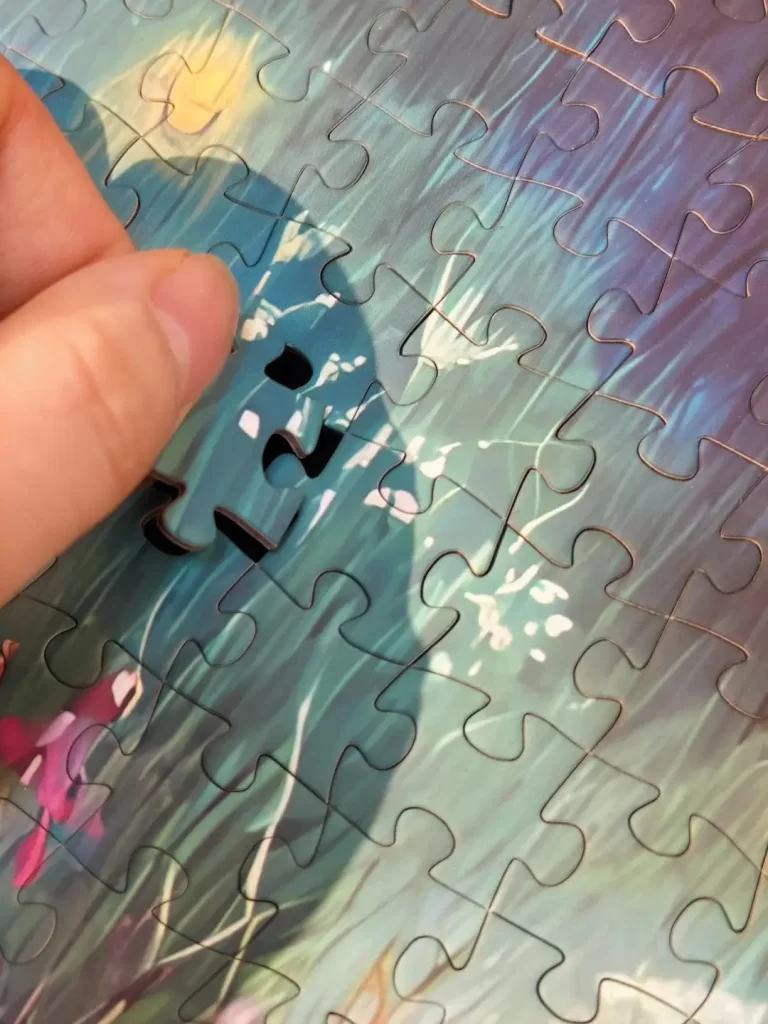
9. Test Cutting Accuracy and Piece Fit
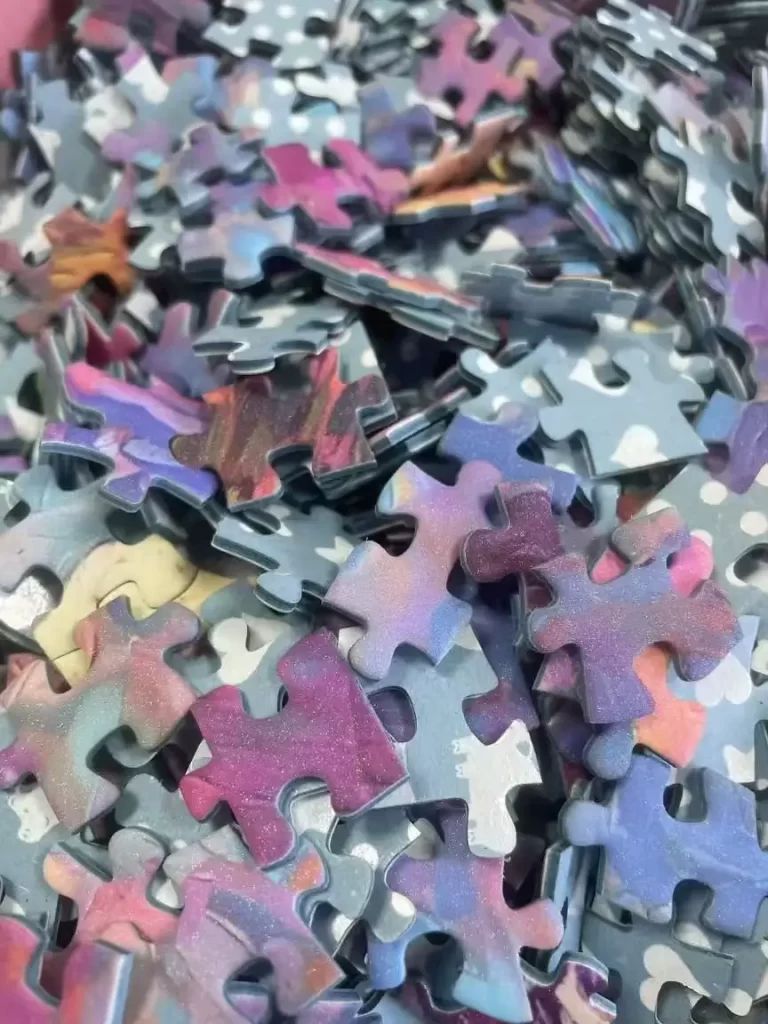
A good puzzle piece should fit securely in its correct position without requiring excessive pressure.
During sample assembly, check for:
- Pieces that are not completely separated
- Attached pairs of pieces
- Torn edges
- Compressed corners
- Loose-fitting pieces
- Pieces that are too tight
- Multiple false fits
- Uneven cutting pressure
- Deformed tabs
- Inconsistent piece sizes
A puzzle should provide enough resistance to feel connected, but customers should not need to force the pieces together.
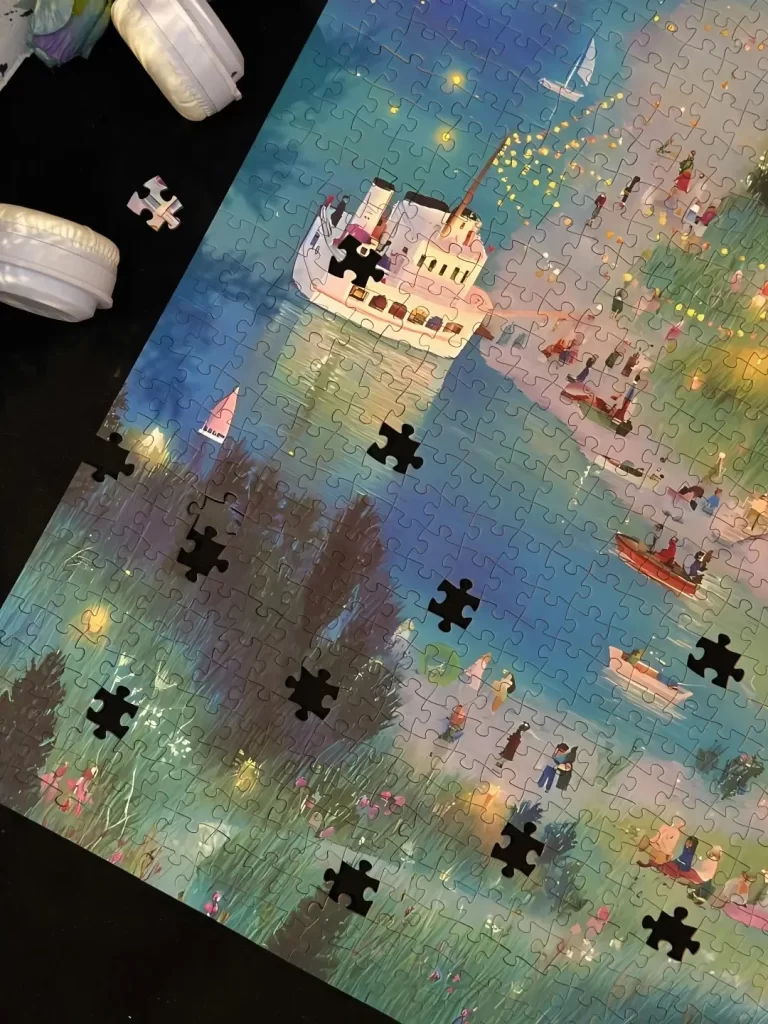
The complete sample should be assembled. Testing only a small section cannot reveal repeated false fits or problems occurring across the full puzzle.
False fits are especially important in designs containing:
- Large areas of sky
- Repetitive flowers
- Similar building windows
- Dark night scenes
- Repeated geometric patterns
- Large areas of one color
Die variety, artwork and backside sorting options can help reduce unnecessary frustration.
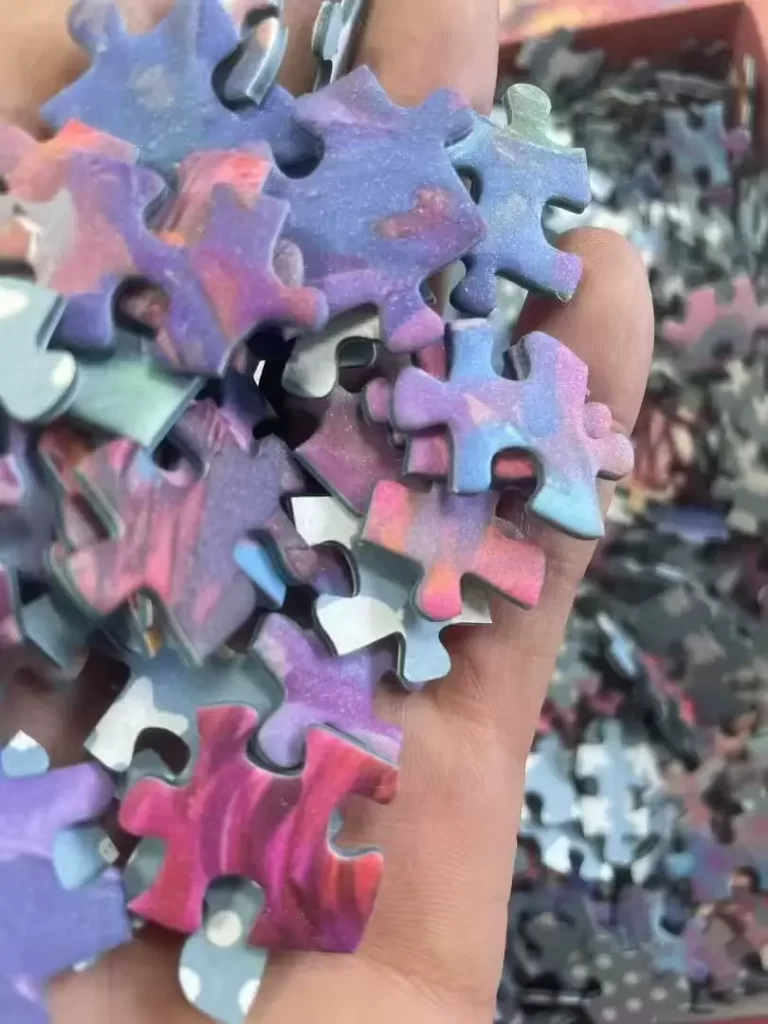
10. Inspect Edges, Dust and Delamination
Puzzle dust is created when paperboard fibers and fragments remain after cutting and piece separation.
A small amount of dust may occur in cardboard products, but excessive dust can make the product feel low quality.
Sample inspection should check for:
- Powder inside the inner bag
- Loose board fibers
- Rough edges
- Fuzzy corners
- Peeling printed paper
- Separation between board layers
- Fraying around tabs and slots
- Cutting marks
- Damage caused during separation
- Surface scratches
Material quality, glue application, mounting, die sharpness, cutting pressure and cleaning procedures all affect the result.
A good puzzle piece should maintain its layers during normal handling and repeated assembly.
11. Decide Whether to Add Backside Sorting Assistance
Backside printing can help customers organize larger puzzles.
Available formats may include:
- Letters
- Numbers
- Colors
- Symbols
- Graphic patterns
- Grid sections
For example, a 1,000-piece puzzle can be divided into several zones marked A, B, C, D, E and F.
Customers can first sort pieces by the information printed on the back and then assemble each front section.
Backside sorting may be useful for:
- Beginners
- Large puzzles
- Educational products
- Group activities
- Customers who prefer guided assembly
- Designs with repetitive colors
However, experienced puzzle customers may prefer a traditional unmarked back.
The feature should be selected according to the target market rather than added automatically.
Back printing must also correspond to the correct production version and should not affect the front surface.
12. Verify Missing-Piece Control
A missing piece can make an otherwise excellent puzzle unusable.
The production and packing process should include controls for:
- Complete die cutting
- Piece separation
- Quantity verification
- Inner-bag sealing
- Product-code matching
- Box-and-puzzle matching
- Prevention of mixed designs
- Final packing inspection
Buyers should ask how the production process reduces the risk of:
- A piece remaining in the die-cut sheet
- Pieces falling between machines
- Pieces from two designs becoming mixed
- The wrong inner bag being placed in a box
- Open or damaged bags
- An incorrect puzzle being packed with the box
Depending on the product and order arrangement, weight checks, production-line controls or other verification methods may be used.
A clear replacement-parts or missing-piece process is also valuable for retail brands.
13. Compare Packaging Structures
Puzzle packaging affects product protection, shelf presentation, freight cost and perceived retail value.
Available options may include:
- Lid-and-base boxes
- Hinged boxes
- Flip-top boxes
- Drawer boxes
- Tuck-end boxes
- Carry-handle boxes
- Tin boxes
- Paper tubes
- Plastic tubes
- Magnetic boxes
- Irregular-shaped boxes
- Double-insert boxes
- Gift boxes
- Compact travel packaging
When choosing packaging, consider:
- Box strength
- Opening experience
- Board thickness
- Inner bag
- Reference poster
- Barcode position
- Age label
- Warning information
- Retail hanging requirements
- Shelf dimensions
- Parcel-shipping protection
- Master-carton efficiency
- Plastic-reduction goals
A large decorative box may improve shelf presentation but can also significantly increase logistics costs.
For e-commerce products, the retail box should be evaluated under individual parcel-delivery conditions, not only in a master carton.
14. Confirm Artwork Rights and Product Requirements
Buyers should confirm that they own the artwork, have commissioned it under suitable commercial terms or have obtained permission to use it.
Particular care is required when a design contains:
- Movie characters
- Animation characters
- Game artwork
- Celebrity photographs
- Logos
- Book illustrations
- Licensed brand elements
- Protected artwork
- Recognizable commercial properties
For customer-supplied artwork, the buyer should confirm that it has the necessary commercial usage rights.
Children’s puzzles may also require additional attention to:
- Age grading
- Piece size
- Small-parts warnings
- Material requirements
- Packaging labels
- Product testing
- Destination-market rules
Available factory and product documentation may include quality-management systems, social audits, material reports or product tests.
However, a general factory certificate does not automatically apply to every puzzle.
Before production, buyers should confirm whether the available documents correspond to:
- The selected production facility
- The actual board and coating
- The ordered puzzle
- The recommended age
- The packaging
- The destination market
- The current validity period
Additional testing may be required when the material, finish, packaging or target age changes.
15. Approve a Physical Sample and Written Specification
A digital proof or product photograph is not enough for a bulk puzzle order.
A physical sample should be opened, inspected and completely assembled.
The sample review should cover:
- Board material
- Board thickness
- Finished size
- Piece count
- Printing quality
- Color accuracy
- Surface finish
- Die pattern
- Piece fit
- False fits
- Edge quality
- Puzzle dust
- Back printing
- Inner bag
- Reference poster
- Box structure
- Packaging protection
- Barcode and labels
The final written specification should record:
- Product code
- Artwork version
- Board material
- Board thickness
- Finished dimensions
- Piece count
- Printing method
- Surface finish
- Die number
- Backside-printing format
- Inner packaging
- Box dimensions
- Packaging artwork
- Carton quantity
- Testing requirements
- Approved sample reference
- Replacement policy
Any change after sample approval should be documented before bulk production begins.
Custom Jigsaw Puzzle Options from Gami Crafts
Gami Crafts Co., Ltd. supports wholesale, OEM/ODM and private-label jigsaw puzzle projects.
Available options may include the following.
Piece Counts
- Large-piece children’s puzzles
- Low-piece-count educational puzzles
- 100-piece puzzles
- 300-piece puzzles
- 500-piece puzzles
- 1,000-piece puzzles
- Higher-piece-count projects
- Customized piece counts
Materials
- Gray board
- White board
- Blue-core board
- Wooden materials
- Magnetic materials
- Project-specific materials
Puzzle Formats
- Standard rectangular puzzles
- Round puzzles
- Irregular-shaped puzzles
- Silhouette puzzles
- Framed puzzles
- Mini puzzles
- Tube puzzles
- Large-piece puzzles
- Layered puzzles
- 3D puzzle products
Surface Treatments
- Gloss
- Matte
- Velvet
- Fine glitter
- Holographic
- Brushed
- Embossed
- Hot foil
- Linen-style texture
- Glow-in-the-dark
- Pearlescent
- Reflective effects
Packaging Options
- Standard retail boxes
- Custom color boxes
- Lid-and-base boxes
- Hinged boxes
- Drawer boxes
- Tin boxes
- Paper tubes
- Plastic tubes
- Carry-handle boxes
- Magnetic boxes
- Irregular boxes
- Gift packaging
- E-commerce packaging
Private-Label Options
- Custom artwork
- Custom logo
- Custom product name
- Custom barcode
- Custom packaging
- Custom reference poster
- Custom instructions
- Custom die
- Custom piece count
- Custom surface finish
- Carton and shipping-mark customization
How a Custom Jigsaw Puzzle Project Works
A typical project may follow these stages.
1. Requirement Review
The buyer provides the product concept, artwork, target customer, piece count, size, board material, surface finish, packaging requirements, order quantity and destination market.
2. Artwork and Specification Review
The artwork resolution, bleed, crop, color and commercial usage rights are reviewed.
Suitable board, die, printing and packaging options are then discussed.
3. Digital Proof and Quotation
The puzzle layout and packaging artwork are prepared for approval.
Pricing is confirmed according to the final product specification and order quantity.
4. Physical Sample
A sample is produced using the agreed board, finish, die and packaging.
5. Complete Sample Assembly
The sample puzzle is fully assembled to check color, cutting, fit, completeness and customer experience.
6. Bulk Production
Printing, mounting, surface finishing, die cutting, packing and quality inspection are completed according to the approved sample and specification.
7. Final Inspection and Shipping
Product quantity, packaging, cartons, labels and shipping marks are checked before dispatch.
Gami Crafts Jigsaw Puzzle Range
Only selected jigsaw puzzle examples are currently displayed on the Gami Crafts website.
They represent only a small part of our available product resources.
Our broader range includes many additional:
- 500-piece designs
- 1,000-piece designs
- Animal themes
- Floral themes
- Landscape themes
- City scenes
- Food themes
- Seasonal themes
- Fantasy designs
- Fine-art-style designs
- Different board materials
- Different surface treatments
- Multiple packaging formats
- Custom artwork projects
Current product specifications include examples of 1,000-piece puzzles with finished dimensions around 70 × 50 cm and 500-piece puzzles around 52 × 38 cm.
Available surface options include velvet, fine-glitter, holographic, brushed and gloss-style finishes.
Buyers can contact Gami Crafts for the current catalog, product recommendations and customization options instead of relying only on the selected products published online.
Why Choose Gami Crafts for Custom Jigsaw Puzzles?
Gami Crafts Co., Ltd. combines its own production facilities with selected specialist manufacturing resources for puzzle printing, die cutting, box production and packaging.
This enables us to support:
- Ready-design jigsaw puzzles
- Customer artwork
- Different board materials
- Multiple piece counts
- Standard and custom dies
- Specialty surface finishes
- A wide range of packaging
- OEM/ODM development
- Private-label production
- Sample development
- Quality-control coordination
- Small trial orders
- Larger wholesale projects
- Product and market-specific documentation
We help buyers compare materials, define product specifications, review samples, coordinate customization and identify potential problems before bulk production.
Frequently Asked Questions
What is the best board for a custom jigsaw puzzle?
There is no single best material for every project. Blue-core, gray and white boards can all be suitable when their density, thickness, flatness, layer bonding and cutting performance match the product requirements.
What is a common size for a 1,000-piece puzzle?
Many current Gami Crafts adult 1,000-piece cardboard puzzles have a finished size of approximately 70 × 50 cm. Other dimensions can be customized.
What size is commonly used for a 500-piece puzzle?
Selected Gami Crafts 500-piece products use a finished size of approximately 52 × 38 cm. The final size depends on the artwork, piece dimensions and target market.
Can the puzzle piece count be customized?
Yes. Piece count, finished size, individual piece size and die pattern can be customized according to production feasibility and project requirements.
Can Gami Crafts produce irregular-shaped puzzles?
Yes. Standard, round, irregular, silhouette, framed, large-piece, mini and other die formats can be supported.
What surface finishes are available?
Options may include gloss, matte, velvet, glitter, holographic, brushed, embossed, foil, linen-style, glow-in-the-dark and pearlescent effects.
Can the puzzle box be customized?
Yes. Artwork, logo, box structure, barcode, inserts, poster, labels, inner packaging and master-carton information can be customized.
Should the full puzzle sample be assembled before ordering?
Yes. Complete assembly helps identify false fits, missing pieces, unclear artwork, cutting problems, inaccurate back printing and other issues that may not be visible in photographs.
Can a buyer provide its own artwork?
Yes, provided the buyer owns the artwork or has the necessary permission and commercial usage rights.
Do children’s puzzles have different requirements?
They may require different piece sizes, age grading, warning labels, materials and product testing depending on the product and destination market.
Does the Gami Crafts website show the complete puzzle range?
No. The website displays selected examples. Additional designs, specifications, materials, finishes and customization options are available on request.
Conclusion
Choosing a custom jigsaw puzzle manufacturer requires more than comparing unit prices.
Board quality, printing, surface treatment, die design, piece fit, dust control, piece completeness, packaging, artwork rights and product-specific requirements all affect the finished product.
The most reliable approach is to define a detailed specification, approve a physical sample and completely assemble the puzzle before authorizing bulk production.
Gami Crafts Co., Ltd. supports wholesale jigsaw puzzles, custom artwork, OEM/ODM production and private-label packaging through its own production facilities and selected specialist manufacturing resources.
Contact us to request the latest jigsaw puzzle catalog, material samples, custom packaging options, sample development or a wholesale quotation.